Majestic Mountains: Preclass
For this level 3 class, you probably have most of the supplies you’ll need since you’ve got some experience under your belt before taking this course! Use the brushes and colors YOU love, though I’ll tell you what I’m using. Mountains are forgiving so you can try all kinds of fun mixes!
How class works
During World Watercolor Month, lessons will be realeased one by one on Wednesday mornings, 6am Pacific time. (Once the month is complete, the course will be open to all registrants at one time, no need to wait for lessons.)
If you wish, you can participate in a zoom call – these will be at 4pm Pacific time, and the link will be provided in each lesson. These calls will be about an hour unless there’s gobs of questions; we’ll watch the video together in zoom, you can paint along – and if you have a question just speak up and I can stop the video to respond. What would you perhaps like to know?
- Which brush is that?
- How wet is the paper?
- How did you decide on that mix?
- etc. Especially anything I forgot in the voiceover!
After watching together, students can share their painting, we can talk further about strategies for that painting for those who will try it a second time.
Replays will be added to the lesson page the following day so I have time to get it processed.
And after that, all students will have those videos available as well.
Before we start…a little housekeeping
I retain the copyright to the content you are learning in class. That means…
- Do not sell or give away the concepts from my classes – you may not re-teach my instruction contained or created within these lessons.
- Do not post a video tutorial or step by step photo tutorial of your own redraw of class content.
- Do not repost any handouts you receive in class.
However…I love to see students making strides and taking this teaching and personalizing it with your own skills.
- DO make your own designs and develop your own style! I love that!
- DO gift your creations made with these techniques, of course!
At the bottom of each lesson you’ll see some ways to share your homework and ask questions, so that’ll be handy for you.

Palette
I’ll be using my House of Hoffman palette with big big wells; if yours has tiny mixing areas you may want to have some small finger bowls handy. I’m known for never mixing enough of a color, but the great thing about multicolor mixes – they can absolutely change as the mountain moves in and out of shadows and sun!
As mentioned I’ll be using my fave natural hair brushes, but you can most definitely play with what you have. If you get results different than mine and want to try a new brush, then you can go shopping. Just do come back here to grab links! Your purchases support my work at no cost to you.
Watercolor Paper
Good paper is important! If you’re using a student grade paper, you’ll get very different washes, including blooms or runs that you won’t see in the same way in the demos.
Paintings will be created at 5″ x 7″. I recommend getting a sheet and cutting it down, it’s less expensive, but I’ve also included pads in the list below.
Cold press vs rough? Again, personal choice. I get way better drybrush effects and beautiful edges on rough, but it can be challenging for small details. Most artists use cold press. (I don’t recommend hot press at all for this course.) I’ll use cold press for this course.
Here’s some good papers I can recommend – if you want a really white paper go for “bright” or “high” white, otherwise it’ll be a variation on cream.
- Arches
- Natural Cold Press 140lb full sheet, 22″ x 30″ BLICK
- Bright White Cold Press 140lb full sheet, 22″ x 30″ BLICK
- Natural Rough 140lb full sheet, 22″ x 30″ BLICK
- Bright White Rough 140lb full sheet, 22″ x 30″ BLICK
- Arches Cold press 9×12 pad BLICK | AMZ| JACKSONS
- Arches Rough 9×12 pad BLICK| AMZ | JACKSONS
- Saunders Waterford
Watercolor paints
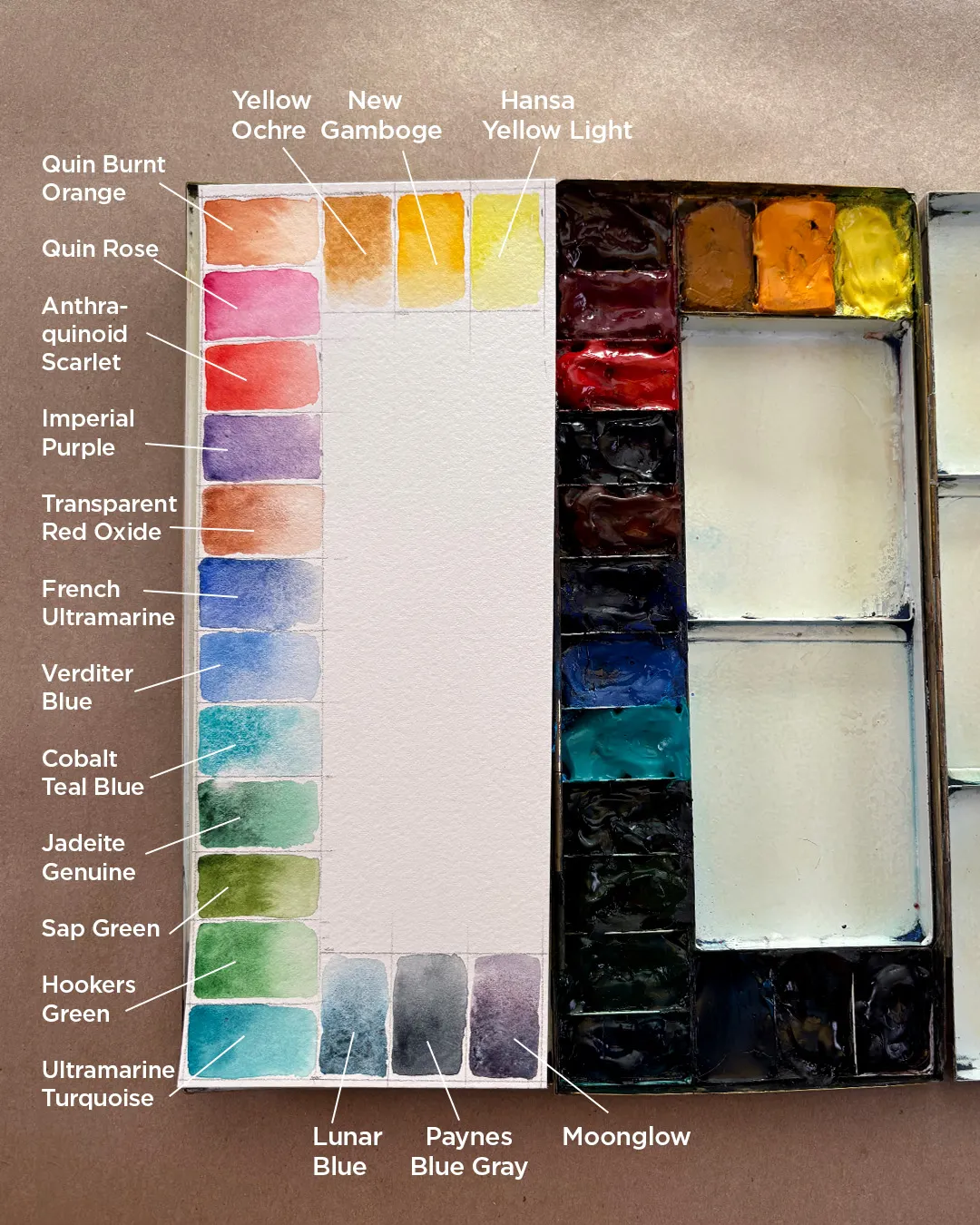
I’ll be using the Daniel Smith colors in my Studio palette; I’m putting the colors I KNOW I used in bold, but I’m making this list before processing everything.
- Hansa Yellow Light BLICK | AMZ | JACKSONS
- New Gamboge BLICK | AMZ | JACKSONS
- Yellow Ochre BLICK | AMZ | JACKSONS
- Quinacridone Burnt Orange BLICK | AMZ | JACKSONS
- Quinacridone Rose BLICK | AMZ | JACKSONS
- Anthraquinoid Scarlet BLICK | AMZ | JACKSONS
- Imperial Purple BLICK | AMZ | JACKSONS
- Transparent Red Oxide BLICK | AMZ JACKSONS
- French Ultramarine BLICK | AMZ | JACKSONS
- Verditer Blue BLICK | AMZ | JACKSONS
- Cobalt Teal Blue BLICK | AMZ | JACKSONS
- Jadeite Genuine BLICK | AMZ | JACKSONS
- Sap Green BLICK | AMZ | JACKSONS
- Hookers Green BLICK | AMZ | JACKSONS
- Ultramarine Turquoise BLICK | AMZ | JACKSONS
- Lunar Blue BLICK | AMZ | JACKSONS
- Paynes Blue Gray | BLICK | AMZ JACKSONS
- Moonglow BLICK | AMZ JACKSONS
Brushes
It’s always a good day to treat yourself to a new brush. The needle brush is used extensively in this course, I highly recommend it. For detail I used a Sable 4 – but if you prefer a synthetic with some snap then go for that 🙂
This is my full rotation of brushes, and I’m writing this page before processing the video footage – so I’m not certain I’ve used them all! I’ll be detailing that in each lesson.
- Escoda Joseph Zbukvic #16 Mop Jacksons
- Winsor & Newton Kolinsky Sable Series 7 Round 8 brush AMZ
- Da Vinci Series 17 Maestro Long Needle Red Sable, Size 8 or 9 Blick | AMZ
- Da Vinci Mottler Flat Wash Blick | AMZ | Jacksons
- Da Vinci Maestro Kolinsky Sable Round 4 BLICK | AMZ | JACKSONS
- Da Vinci Cosmotop Spin Brush Round 2 BLICK | AMZ | JACKSONS
Miscellaneous supplies
- Spray bottle – can be any kind
- White artist tape, 3/4” – white helps keep color distraction away from your art
- Kneaded Eraser and a regular pencil
- A 12×16 Ampersand Hardbord to tape the paper down to.
- White gouache though this is NOT used in class, you may want it on hand if you’re new to leaving whites.
Share homework & ask questions
Artventure Community
Join our active art community of thousands of artists on the Mighty Networks app or on the web. You can get quick feedback, help, and answers, as well as getting to know other artists near you and around the globe! Free to join.
Monthly Open Studio
Sign in for one of our Zoom calls – “office hour” as a community! Submit work for critiques, questions about techniques, get to know fellow students! See the calendar at Artventure for upcoming dates. Replays available free for 1 week.
Discover more from Art Classes
Subscribe to get the latest posts sent to your email.